
How Much Does AC Repair Cost in Toronto in 2026?
Compare AC repair costs using the diagnosed fault, parts, labour, refrigerant work, warranty, and complete written quote rather than an unsupported market estimate.
10 min read | Updated 2026-10-07
Published by GTA HVAC Pros.
Toronto AC repair cost: the quick answer
The price of an air conditioner repair depends on the diagnosed fault and the work needed to resolve it. A service-call charge, component replacement, refrigerant leak repair, and coil or compressor job cover different scopes and cannot be compared as one standard repair price.
Ask for the exact part, diagnostic time, labour, refrigerant work, after-hours charges, warranty coverage, applicable tax, and total in writing. Equipment condition, access, part availability, and the test findings determine the proposed work. The checklist below identifies quote items rather than claiming unverified Toronto market prices.
A low advertised service-call fee is not the same as a completed repair price. The useful number is the written total after the technician has tested the system and identified the failed component.
| Repair or service | Ask the quote to identify | What changes the scope |
|---|---|---|
| Diagnostic or service call | Fee, included tests, and any credit against approved work | After-hours timing, travel, and further testing |
| Capacitor replacement | Confirmed fault, exact rated part, and labour | Single vs dual-run capacitor, access, and emergency timing |
| Contactor or relay replacement | Confirmed fault, rated replacement, and wiring scope | Part rating, wiring condition, and labour |
| Condensate drain repair | Blockage or failed component and proposed drainage work | Clearing vs pump, trap, or damaged drain work |
| Thermostat repair or replacement | Exact control and compatible wiring or setup work | Thermostat model, wiring, and equipment compatibility |
| Condenser fan motor | Compatible motor, related parts, labour, and warranty | Motor type, blade, capacitor, and availability |
| Leak detection and repair | Test method, located leak, repair, and refrigerant work | Leak location, access, recovery, evacuation, and charge |
| Evaporator coil replacement | Matched coil, installation, testing, and warranty coverage | Equipment match, refrigerant, access, and warranty |
| Compressor replacement | Failure findings, replacement, cleanup, and startup checks | System match, refrigerant, warranty, and circuit condition |
What the diagnostic fee should cover
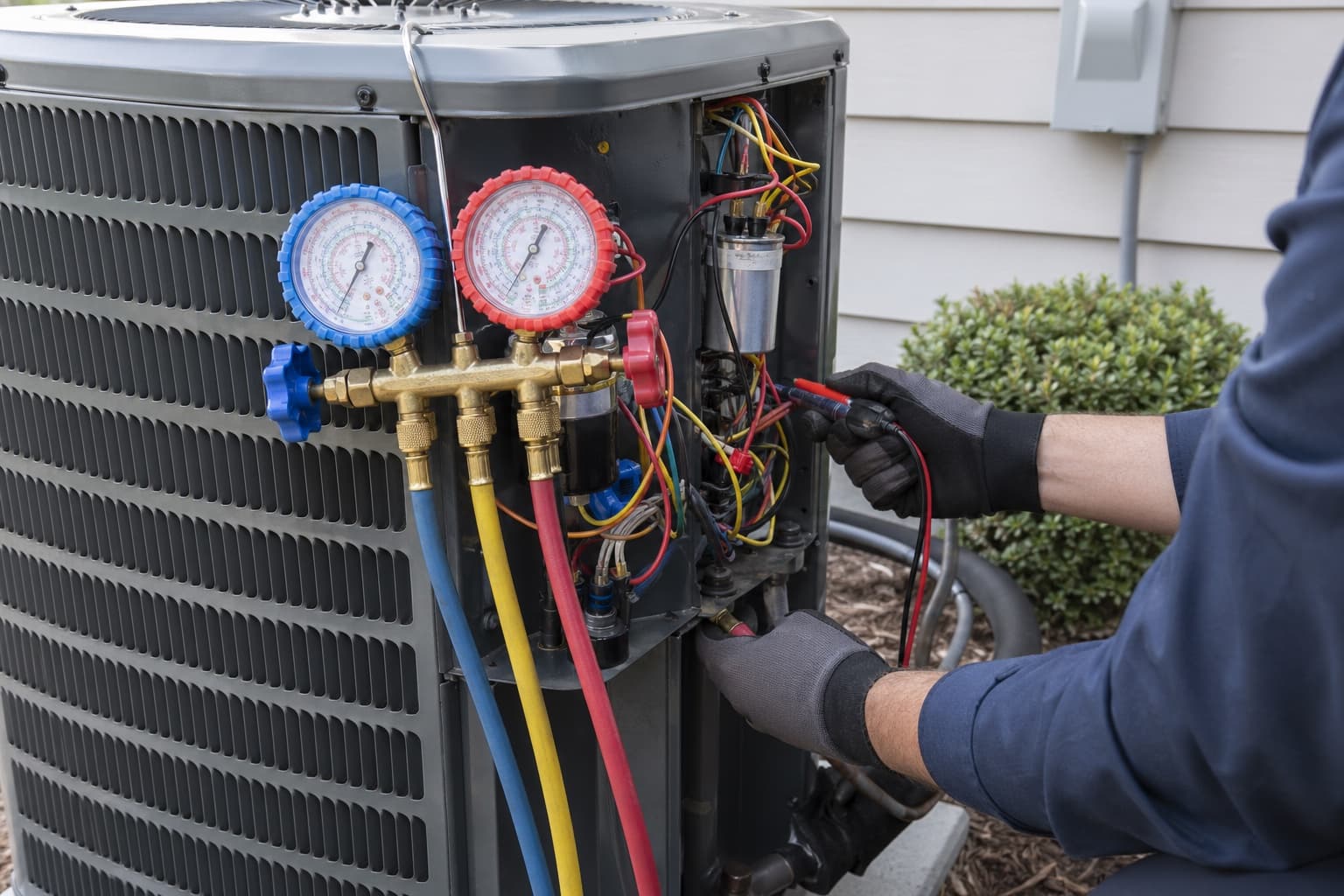
A proper diagnostic visit pays for fault isolation, not merely for a technician to arrive. The first checks normally confirm the thermostat call, filter and airflow condition, indoor blower operation, outdoor disconnect and breaker, condenser fan, compressor startup, and visible coil condition.
Electrical testing may include the capacitor, contactor, voltage, and motor current. Refrigerant pressures and temperature readings may be added when symptoms point to a charge, restriction, or coil problem. The technician should be able to explain which test result supports the recommended repair.
Ask before booking whether the diagnostic fee is separate or credited toward an approved repair. Either model can be reasonable. What matters is that the policy is clear before the visit and that no additional work starts without your authorization.
Why capacitor and contactor repairs are common
The capacitor helps the compressor and fan motor start and run. Heat, age, voltage stress, and long summer cycles can weaken it. A failed capacitor can leave the outdoor unit humming, clicking, or completely silent while the indoor blower still moves warm air.
The contactor is the electrically controlled switch that sends power to the outdoor equipment. Its contacts can pit or burn over time. A technician should test these parts instead of replacing both automatically, because a failing motor or compressor can also damage a new capacitor.
These are usually repairable failures when the rest of the system is in good condition. The quote should identify the part being replaced, the labour charge, and whether the diagnostic fee is already included.
Refrigerant leaks cost more than a simple recharge
Central AC refrigerant is contained in a sealed circuit. If the system is low, there is a leak or a previous service issue. Adding refrigerant without finding the cause may restore cooling temporarily, but it does not solve the underlying problem.
Leak work varies because an accessible fitting is different from a leak inside an evaporator coil or a buried line set. The bill may include electronic or pressure testing, recovery, repair, evacuation, a vacuum hold test, and the refrigerant required to commission the system again.
Natural Resources Canada advises having leaks repaired and refrigerant recycled during service. Ask the contractor to separate leak detection, repair, and refrigerant on the quote so you can see what is driving the total.
What changes fan motor, coil, and compressor scope
For a condenser fan motor repair, ask whether the quote includes a compatible motor, blade work, capacitor or wiring work, labour, and warranty. Access and part availability can affect scope and timing.
Evaporator coils and compressors involve more labour and refrigerant handling. A coil replacement can require opening the indoor cabinet, matching the replacement to the outdoor equipment, pressure testing, evacuation, and recommissioning. A compressor replacement adds electrical diagnosis and may require cleaning the refrigerant circuit after an internal failure.
Before approving either repair, confirm the remaining parts warranty and get a replacement quote for comparison. A large repair can still make sense on newer equipment under warranty; the same repair on an older, repeatedly failing unit may not.
Emergency and after-hours AC repair pricing
Evening, weekend, and heat-wave calls can carry a higher dispatch or labour rate. Ask for the after-hours fee, diagnostic fee, and minimum charge when you book. Also ask whether the quoted repair can be completed immediately or whether the visit is diagnostic only until a part supplier opens.
If the home includes an older adult, infant, or someone with a health condition, tell the dispatcher. Toronto Public Health advises extra care when indoor temperatures remain above 26°C for people vulnerable to heat and lists public cooling options when a home cannot be cooled safely.
Do not keep resetting a breaker that trips repeatedly, open electrical panels, or try to start a compressor manually. Shut the system off and wait for qualified service if there is burning odour, smoke, damaged wiring, or repeated electrical tripping.
When AC repair is usually the better decision
Repair normally makes sense when the failure is isolated, the system has been reliable, compatible parts are available, and the equipment still delivers acceptable comfort. A capacitor, contactor, drain, thermostat, or fan motor does not automatically justify replacing the entire air conditioner.
Warranty coverage matters. A manufacturer parts warranty may cover the component while leaving labour, refrigerant, shipping, or diagnostic time to the homeowner. Ask the contractor to verify the model and serial number before assuming a warranty applies.
Also consider the cause. Replacing a failed part without correcting dirty coils, restricted airflow, a damaged fan blade, or an electrical problem can shorten the life of the new component.
When to compare repair with AC replacement
Request both numbers when the repair involves a compressor or coil, the system has had repeated failures, refrigerant is difficult to source, or comfort was poor before the breakdown. Age is useful context, but the actual equipment condition and repair history matter more than a single cutoff.
Compare complete scopes. A replacement quote should identify the exact model, capacity, efficiency rating, electrical or line-set work, thermostat, permits where applicable, old-unit disposal, commissioning, manufacturer warranty, and labour warranty.
Do not let a repair estimate turn into a pressure sale. Ontario consumer guidance recommends written, itemized estimates and clear contract terms. If additional work appears after the original scope, get the revised price and approve the change in writing.
Safe checks before you pay for a service call
Confirm the thermostat is set to cooling, the target is below the current room temperature, and the fan is set to auto. Replace a visibly dirty filter with the correct size. Make sure supply registers and return grilles are open and unobstructed.
Check the electrical panel once. If the AC breaker is tripped, reset it a single time only after the equipment has been off for several minutes. If it trips again, leave it off and call for service. Repeated resets can worsen an electrical or compressor problem.
Look for ice on the insulated copper line or indoor coil. If you see ice, turn cooling off and let the blower run to thaw it. Do not chip the ice. A frozen system often points to restricted airflow, a blower problem, or low refrigerant and needs diagnosis if it returns.
Keep leaves and debris away from the outdoor condenser, but do not remove panels or reach inside. Natural Resources Canada notes that clean filters and coils protect airflow, efficiency, capacity, and compressor life.
How to compare two Toronto AC repair quotes
Ask each company to identify the failure, the test that confirmed it, the exact part, labour, diagnostic fee, refrigerant quantity if relevant, warranty, HST, and total. Quotes are only comparable when they cover the same work.
A useful written repair quote answers five questions: What failed? What caused it? What will be replaced or repaired? What is excluded? What warranty applies to the part and labour? If the contractor cannot explain those points, a second diagnosis may be worth the cost.
For urgent repairs, speed matters, but clarity still matters. A documented diagnosis gives you a record if the same symptom returns and makes future repair-versus-replacement decisions easier.
Sources and methodology
See the linked sources for supporting guidance. It is general planning information, not a substitute for an on-site diagnosis, manufacturer instructions, emergency response, or a written quote.
- Natural Resources Canada — Air Conditioning Your Home
Maintenance, airflow, refrigerant-leak, and qualified-service guidance.
- Ontario — Your Rights When Starting Home Renovations or Repairs
Written estimate, contract, warranty, and change-order guidance.
- City of Toronto — Keep Cool and Stay Safe
Current local heat-safety and cooling-space guidance.
Related Toronto HVAC guides
Why Your AC Is Not Cooling: Common Causes in Toronto Summers
When the AC runs but the house stays warm, the cause is usually one of a handful of issues. Here is how to narrow it down before you call.
How Much Does AC Installation Cost in Toronto? (2026 Price Guide)
Compare a site-specific AC installation quote using exact matched equipment, cooling-load sizing, ducts, electrical work, removal, startup, and warranty.
HVAC Repair vs Replacement in Toronto
A practical guide to deciding whether a repair is enough or whether replacement deserves a serious quote.